Korean Medicine, Mother's Hands
The Healing My Mother Knew
When I was young and complained of a stomachache—when my belly was full but unmoving, tight like a drum, or when I sat curled in discomfort—my mother would look at me with a knowing expression and say,
“You have chae.”
체했다.
She would say it quietly, with certainty, as if she could see the stuckness in my body—some invisible knot that needed to be undone.
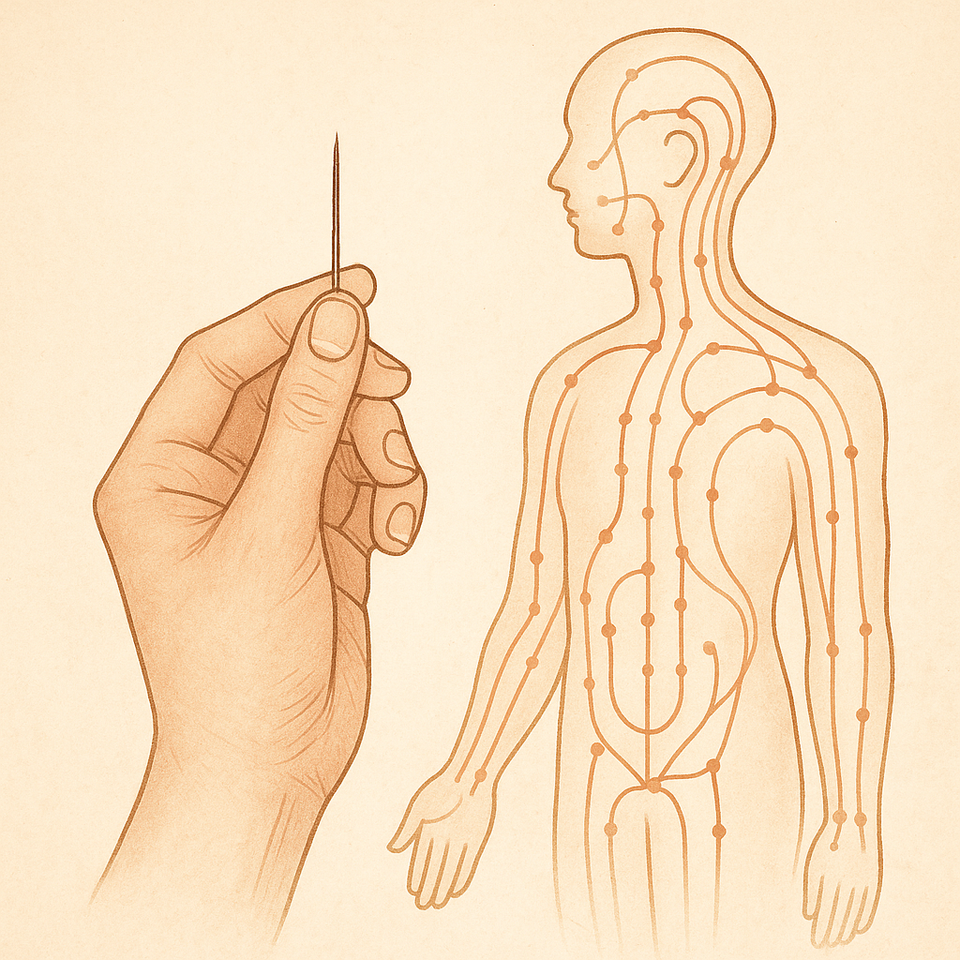
Then she’d reach for a sewing needle. She’d light a match, burn the tip to sterilize it, and hold my small hand gently in hers.
One by one, she would prick my fingertips. Sometimes my toes, too. Tiny beads of blood would rise to the surface.
I remember the pinch, the sting—and then, a strange kind of release. A warmth. A shift. Like something that had been trapped deep inside suddenly let go.
Sometimes I would throw up afterward. Other times, I’d have a bowel movement and feel the pain dissolve. It wasn’t just physical. It was as though energy had moved—through me, out of me, returning me to ease.
Now I know: this was a form of traditional Korean healing. A kind of bloodletting known as soo chim (수침), passed from mothers to daughters for generations. It lives at the intersection of acupuncture, folk medicine, and maternal instinct. It doesn’t come from textbooks—it comes from memory, from watching, from knowing.
He had learned it from his father before him, and that father from his own.
Three generations of healers.
Men who studied roots, meridians, pulse, and qi.
Men who believed the body speaks—if only we learn to listen.
And now, that knowing has passed through my mother’s fingertips into mine.
Their medicine lives in her hands.
They say the fingertips are connected to the meridians of the body—the energetic highways of qi. That pricking them can release stagnation, especially when the gut is overwhelmed. But more than that, I think my mother was telling my body:
“I see where you’re stuck. Let me help you let it go.”
There was no fear in her touch. No panic. Only care. Precision. Devotion.
And now, decades later, when my body feels tight again—when I am under stress, or when old coping patterns whisper their return—I remember those tiny punctures, and the quiet wisdom of my mother’s hands.
She didn’t say much. She didn’t need to.
She knew that sometimes, healing comes not from adding more—but from releasing what the body no longer needs to hold.